





NCERT Class 3 English Santoor Unit 1 Question Answer – Colours
Get NCERT Class 3 English Santoor Unit 1 “Colours” question answers, word meanings, Hindi translations, reading, pronunciation, and easy explanations to help students learn English effectively.
NCERT कक्षा 3 अंग्रेज़ी संतूर यूनिट 1 “Colours” के प्रश्न-उत्तर, शब्दार्थ, हिंदी अनुवाद, रीडिंग, उच्चारण और आसान व्याख्या प्राप्त करें, ताकि विद्यार्थी अंग्रेज़ी को आसानी से और प्रभावी ढंग से सीख सकें।
Unit 1 – Chapter 1
Fun with friends
Picture reading
Look at this picture story.
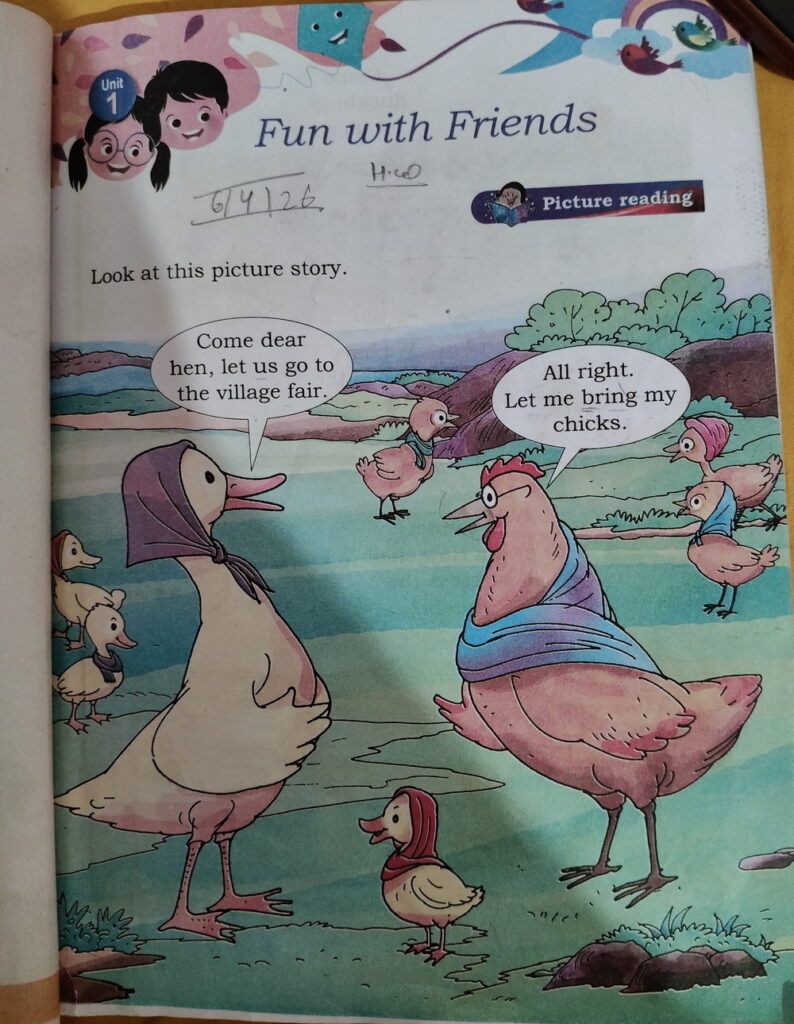
Come dear hen, let us go to the village fair
आओ, प्यारी मुर्गी, चलो गाँव के मेले में चलें।
All right, let me bring my chicks.
ठीक है, मुझे अपने चूज़ों को ले आने दो।
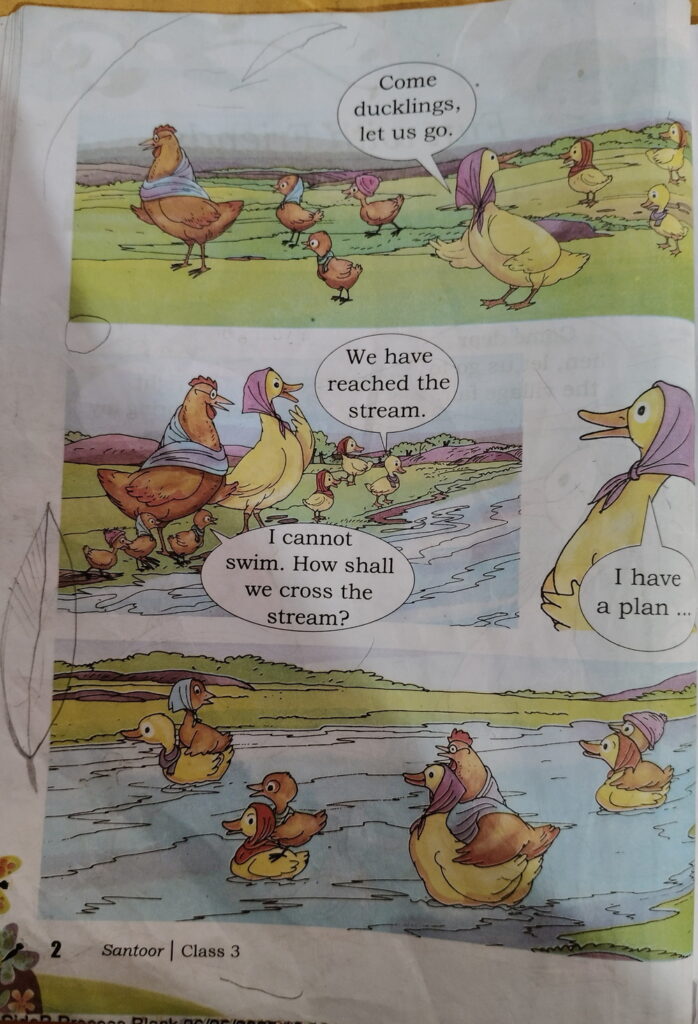
Come ducklings, let us go.
आओ, नन्हे बत्तखों, चलो चलते हैं।
We have reached the stream.
हम नाले के पास पहुँच गए हैं।
I cannot swim. How shall we cross the stream?
मैं तैर नहीं सकती। हम इस नाले को कैसे पार करेंगे?
I have a plan.
मेरे पास एक योजना है।
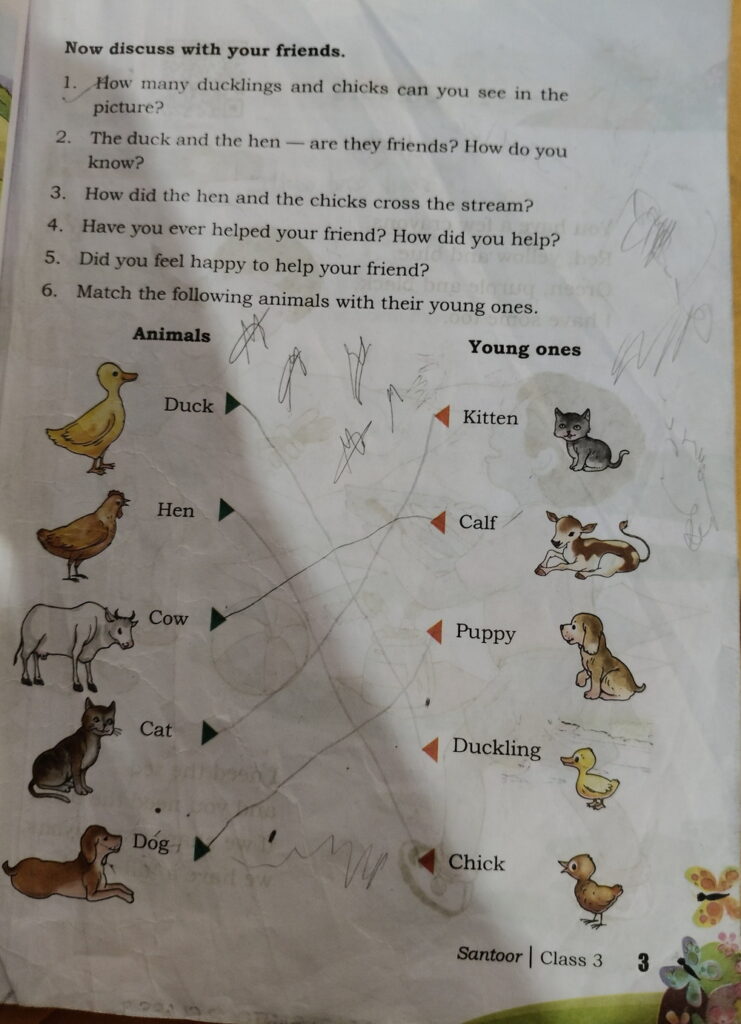
Now discuss with your friends
अब अपने दोस्तों के साथ चर्चा करो।
Q.1 How many ducklings and chicks can you see in the picture?
चित्र में तुम्हें कितने बत्तख के बच्चे और चूज़े दिखाई दे रहे हैं?
Answer:1 There are three ducklings and three chicks in the picture.
चित्र में तीन बत्तख के बच्चे और तीन चूज़े दिखाई दे रहे हैं।
Q.2 The duck and the hen are friends. How do you know?
बत्तख और मुर्गी दोस्त हैं। तुम्हें यह कैसे पता चला?
Answer: 2 Yes, they are friends because the duck helps him cross the stream.
हाँ, वे दोस्त हैं क्योंकि बत्तख मुर्गी को नाला पार करने में मदद करती है।
Q.3 How did the hen and the chicks cross the stream?
मुर्गी और चूज़ों ने नाला कैसे पार किया?
Answer: 3 The hen and her chicks sat on the back of the duck and ducklings, crossed the stream.
मुर्गी और उसके चूज़े बत्तख और उसके बच्चों की पीठ पर बैठ गए और नाला पार कर गए।
Q:4 Have you ever helped your friend? How did you help?
क्या तुमने कभी अपने दोस्त की मदद की है? तुमने उसकी मदद कैसे की?
Answer: 4 Yes! I helped my friend once. They forgot their lunch, so I shared mine with them. We ate together and had fun!
हाँ! मैंने एक बार अपने दोस्त की मदद की थी। वह अपना टिफ़िन लाना भूल गया था, इसलिए मैंने अपना टिफ़िन उसके साथ बाँट लिया। फिर हम दोनों ने साथ में खाना खाया और खूब मज़े किए!
Q.5 Did you feel happy to help your friend?
क्या अपने दोस्त की मदद करके तुम्हें खुशी हुई?
Answer: 5 Yes, I feel happy to help my friend.
हाँ, मुझे अपने दोस्त की मदद करके खुशी होती है।
Q. 6 Match the following animals with their young ones.
निम्नलिखित जानवरों का उनके बच्चों से मिलान करो।
Answer: 6 The image below contains the answers to the questions. The correct name of each animal’s young one is written next to the animal, and the correct matching is also shown below.
नीचे दी गई इमेज में प्रश्नों के उत्तर दिए गए हैं। प्रत्येक जानवर के सामने उसके बच्चे का सही नाम लिखा गया है तथा नीचे सही क्रॉस-मैचिंग भी दिखाई गई है।
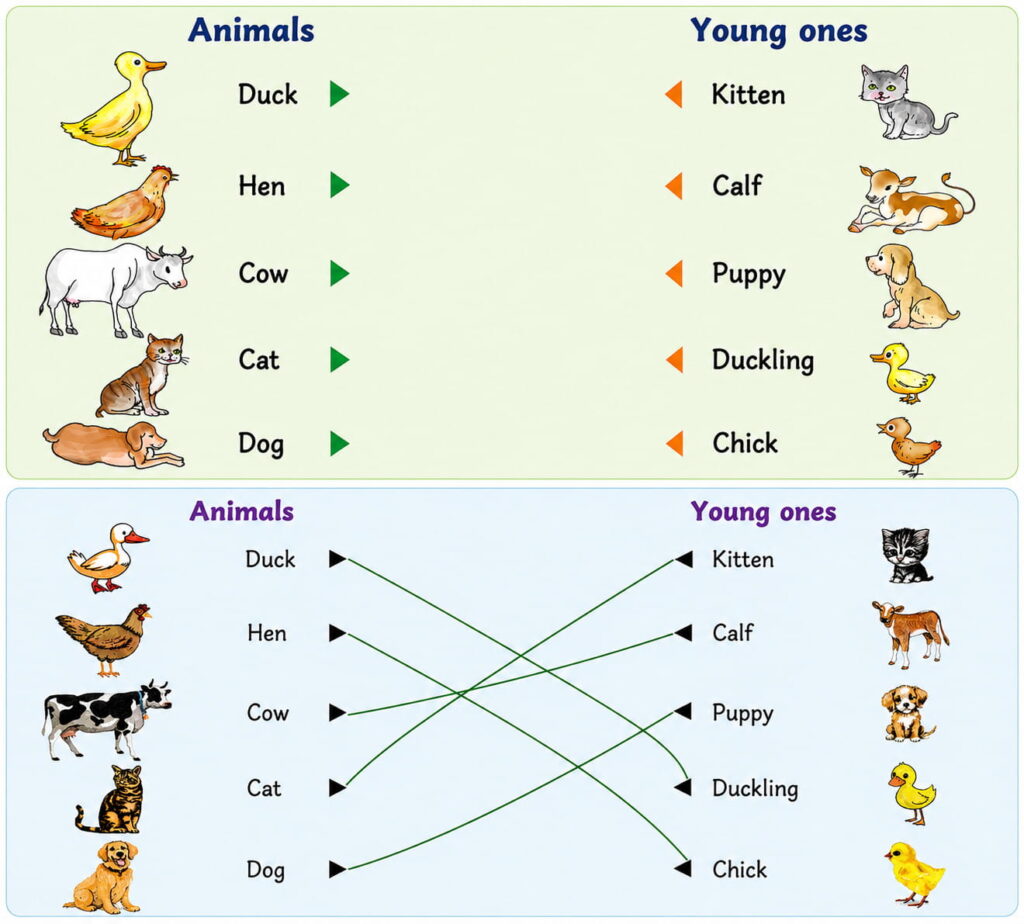
Chapter 1 – Colours (Class 3 English Unite 1)
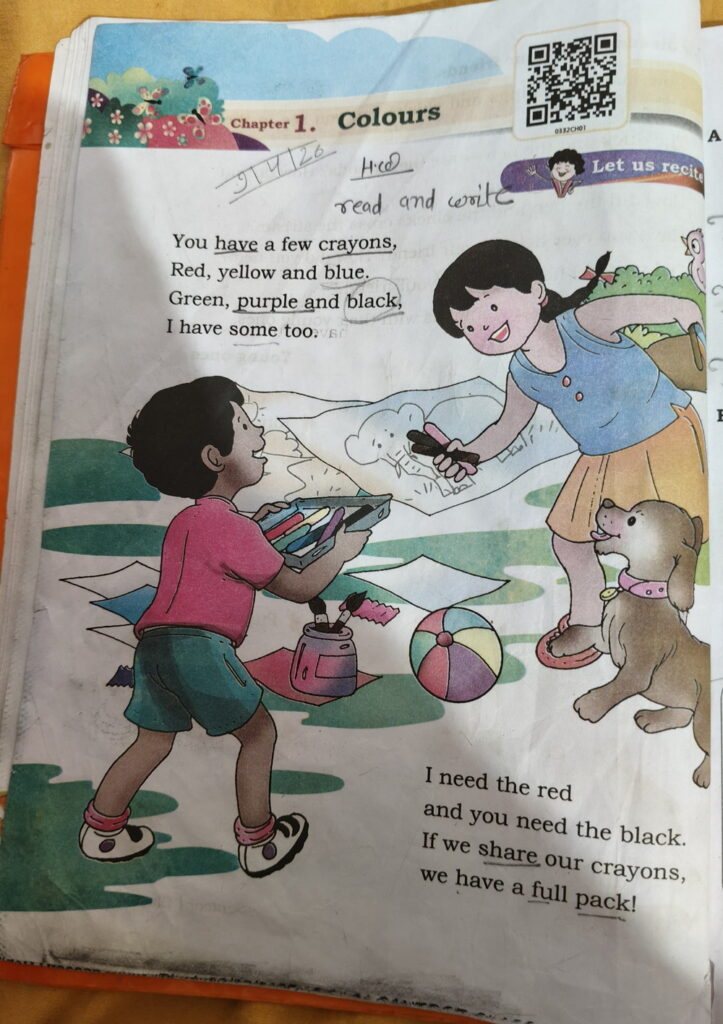
You have a few crayons, red, yellow, and blue, green, purple, and black. I have some too.
तुम्हारे पास कुछ क्रेयॉन हैं—लाल, पीले, नीले, हरे, बैंगनी और काले। मेरे पास भी कुछ क्रेयॉन हैं।
I need the red and you need the black. If we share our crayons, we have a full pack.
मुझे लाल रंग चाहिए और तुम्हें काला रंग चाहिए। यदि हम अपनी रंगीन मोम-क्रेयॉन (क्रेयॉन) आपस में बाँट लें, तो हमारे पास पूरा डिब्बा हो जाएगा।
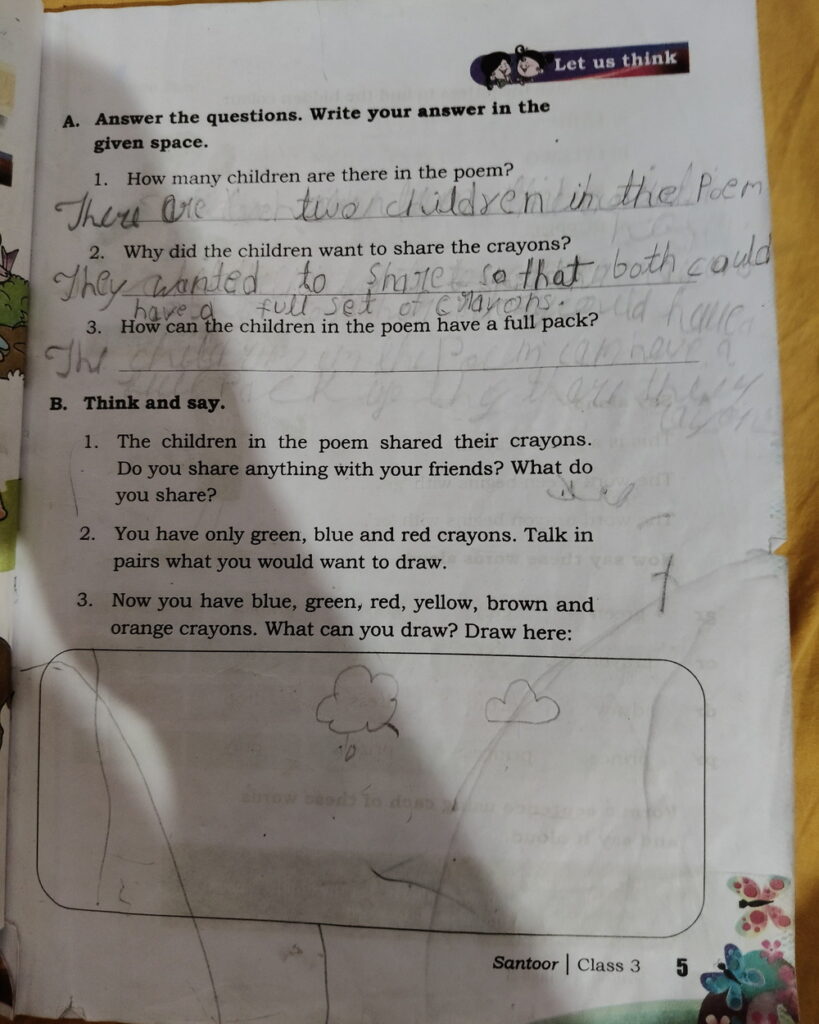
A. Answer the questions. Write your answer in the given space.
प्रश्नों के उत्तर लिखिए। अपना उत्तर दिए गए स्थान में लिखिए।
Q. 1 How many children are there in the poem?
कविता में कितने बच्चे हैं?
Answer: 1 These are two children in the poem.
कविता में दो बच्चों का उल्लेख किया गया है।
Q. 2 Why did the children want to share the crayons?
बच्चे क्रेयॉन (रंगीन मोम-रंग) क्यों बाँटना चाहते थे?
Answer: 2 The children shared the crayons because they both had fewer crayons if they shared the crayons they had a full pack.
बच्चों ने अपने क्रेयॉन आपस में बाँटे क्योंकि उन दोनों के पास कम क्रेयॉन थे। जब उन्होंने अपने क्रेयॉन साझा किए, तो उनके पास क्रेयॉनों का पूरा डिब्बा हो गया।
Q. 3 How can the children in the poem have a full pack?
कविता में बच्चे क्रेयॉनों का पूरा डिब्बा कैसे पा सकते हैं?
Answer: 2 If they share the crayons, they will have a full pack.
यदि वे अपने क्रेयॉन आपस में बाँटेंगे, तो उनके पास क्रेयॉनों का पूरा डिब्बा होगा।
B. Think and say.
Q.1 The children in the poem shared their crayons. Do you share anything with your friends? What do you share?
कविता में बच्चों ने अपने क्रेयॉन आपस में बाँटे। क्या तुम भी अपने दोस्तों के साथ कोई चीज़ साझा करते हो? तुम क्या साझा करते हो?
Answer: 1 Yes, I share my lunch, my water bottle, and my pencil with my friends.
हाँ, मैं अपने दोस्तों के साथ अपना टिफ़िन, अपनी पानी की बोतल और अपनी पेंसिल साझा करता/करती हूँ।
Q: 2 You have only green, blue, and red crayons. Talk in pairs about what you would want to draw.
तुम्हारे पास केवल हरे, नीले और लाल क्रेयॉन हैं। अपने साथी के साथ मिलकर बताओ कि तुम क्या चित्र बनाना चाहोगे।
Answer: 2 I want to use red and green crayons to draw light. I want to use blue and green to draw a cap.
मैं लाइट (दीपक/बत्ती) बनाने के लिए लाल और हरे रंग के क्रेयॉन का उपयोग करना चाहता/चाहती हूँ। मैं टोपी बनाने के लिए नीले और हरे रंग के क्रेयॉन का उपयोग करना चाहता/चाहती हूँ।
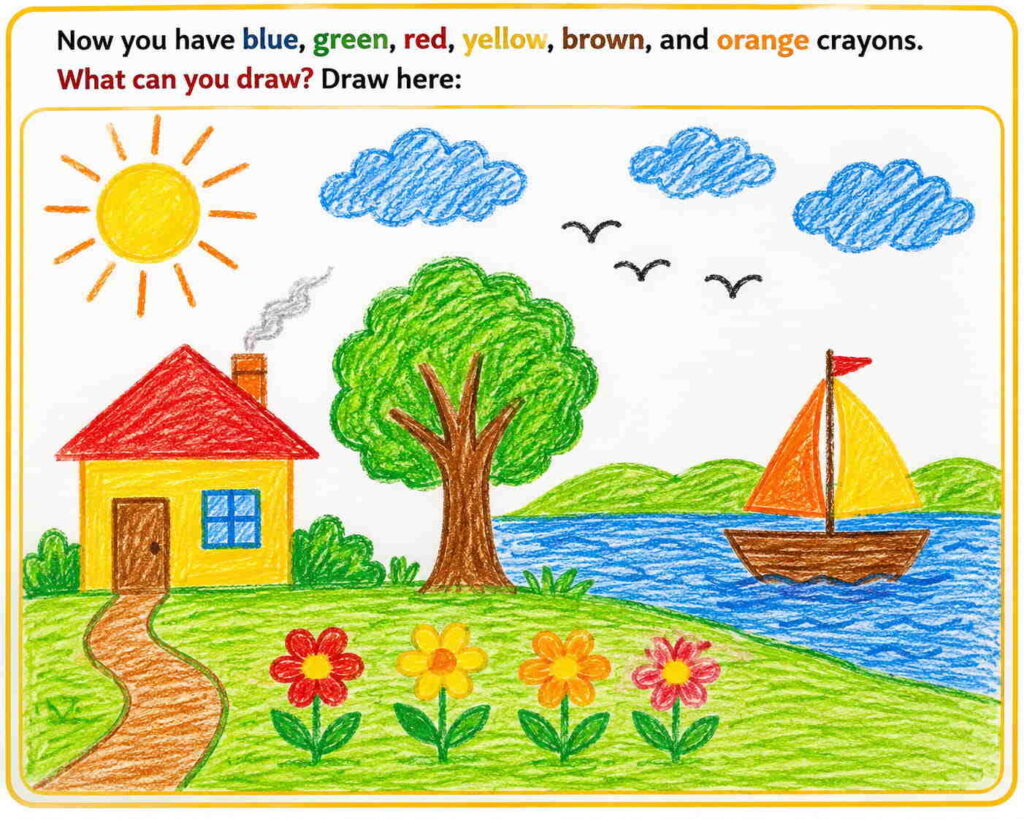
Q. 3 Now you have blue, green, red, yellow, brown, and orange crayons. What can you draw? Draw here:
अब तुम्हारे पास नीले, हरे, लाल, पीले, भूरे और नारंगी रंग के क्रेयॉन हैं। तुम क्या बना सकते हो? यहाँ चित्र बनाओ।
Answer: 3 I made this painting using all these colors.
मैं इन सभी कलर्स को मिलाकर ये पेंटिंग बनाया हूँ.
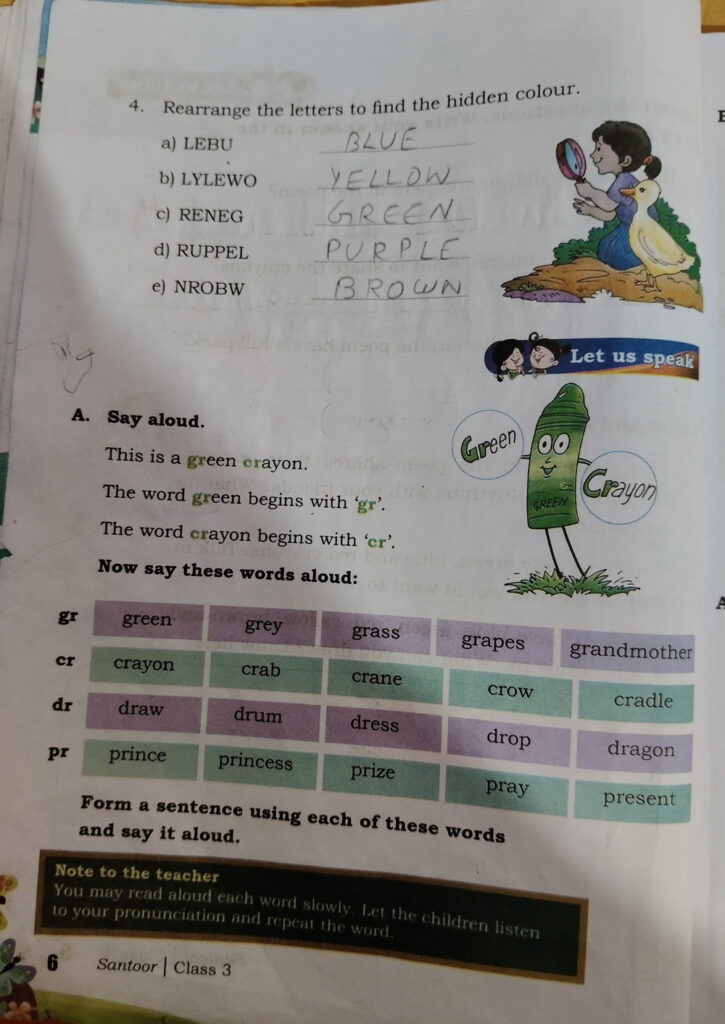
Q. 4 Rearrange the letters to find the hidden colour.
(a) LEBU ____________________
(b) LYLEWO ____________________
(c) RENEG ____________________
(d) RUPPEL ____________________
(e) NROBW ____________________
अक्षरों को सही क्रम में लगाकर छिपे हुए रंग का नाम खोजो।
Answer: 4 Rearranged color names:
सही क्रम में लगाए गए रंगों के नाम
(a) LEBU → Blue
(b) LYLEWO → Yellow
(c) RENEG → Green
(d) RUPPEL → Purple
(e) NROBW → Brown
A. Say aloud. ज़ोर से पढ़ो।
This is a green crayon.
यह हरे (Green) रंग का क्रेयॉन है।
The word green begins with ‘gr’.
‘Green’ (हरा रंग) शब्द की शुरुआत ‘gr’ से होती है।
The word crayon begins with ‘cr’.
‘Crayon’ (रंगीन मोम-रंग) शब्द की शुरुआत ‘cr’ से होती है।
Now say these words aloud: अब इन शब्दों को ज़ोर से बोलो।
Practice reading aloud: ज़ोर से पढ़ने का अभ्यास करें
- Green – ग्रीन – हरा
- Gray – ग्रे – धूसर
- Grass – ग्रास – घास
- Grapes – ग्रेप्स – अंगूर
- Grandmother – ग्रैंडमदर – दादी / नानी
- Crayon – क्रेयन – क्रेयॉन
- Crab – क्रैब – केकड़ा
- Crane – क्रेन – सारस / क्रेन मशीन
- Crow – क्रो – कौआ
- Cradle – क्रेडल – पालना
- Draw – ड्रॉ – चित्र बनाना
- Drum – ड्रम – ढोल
- Dress – ड्रेस – पोशाक
- Drop – ड्रॉप – बूंद
- Dragon – ड्रैगन – ड्रैगन
- Prince – प्रिन्स – राजकुमार
- Princess – प्रिन्सेस – राजकुमारी
- Prize – प्राइज़ – पुरस्कार
- Pray – प्रे – प्रार्थना करना
- Present – प्रेज़ेंट – उपहार
Form a sentence using each of these words and say it aloud. इनमें से प्रत्येक शब्द का उपयोग करके एक वाक्य बनाइए और उसे ज़ोर से बोलकर पढ़िए।
Here are simple sentences for each word, suitable for Class 3 students: यहाँ कक्षा 3 के विद्यार्थियों के लिए प्रत्येक शब्द के सरल वाक्य दिए गए हैं।
- Green – I have a green bag.
हरा – मेरे पास एक हरा बैग है। - Gray – The sky is gray today.
धूसर – आज आसमान धूसर है। - Grass – The cow is eating grass.
घास – गाय घास खा रही है। - Grapes – I like to eat grapes.
अंगूर – मुझे अंगूर खाना पसंद है। - Grandmother – My grandmother tells me stories.
दादी / नानी – मेरी दादी / नानी मुझे कहानियाँ सुनाती हैं। - Crayon – I draw a picture with a crayon.
क्रेयॉन – मैं क्रेयॉन से एक चित्र बनाता/बनाती हूँ। - Crab – The crab lives in the sea.
केकड़ा – केकड़ा समुद्र में रहता है। - Crane – I saw a crane near the building.
सारस / क्रेन मशीन – मैंने इमारत के पास एक क्रेन देखी। - Crow – The crow is sitting on the tree.
कौआ – कौआ पेड़ पर बैठा है। - Cradle – The baby is sleeping in the cradle.
पालना – बच्चा पालने में सो रहा है। - Draw – I like to draw flowers.
चित्र बनाना – मुझे फूलों के चित्र बनाना पसंद है। - Drum – The boy is playing the drum.
ढोल – लड़का ढोल बजा रहा है। - Dress – She is wearing a beautiful dress.
पोशाक – उसने एक सुंदर पोशाक पहनी है। - Drop – A drop of water fell on the table.
बूंद – पानी की एक बूंद मेज पर गिर गई। - Dragon – The dragon is a magical creature.
ड्रैगन – ड्रैगन एक जादुई जीव है। - Prince – The prince lives in a palace.
राजकुमार – राजकुमार महल में रहता है। - Princess – The princess is very kind.
राजकुमारी – राजकुमारी बहुत दयालु है। - Prize – I won a prize in the race.
पुरस्कार – मैंने दौड़ में एक पुरस्कार जीता। - Pray – We pray to God every morning.
प्रार्थना करना – हम हर सुबह भगवान से प्रार्थना करते हैं। - Present – My father gave me a birthday present.
उपहार – मेरे पिता ने मुझे जन्मदिन का उपहार दिया।
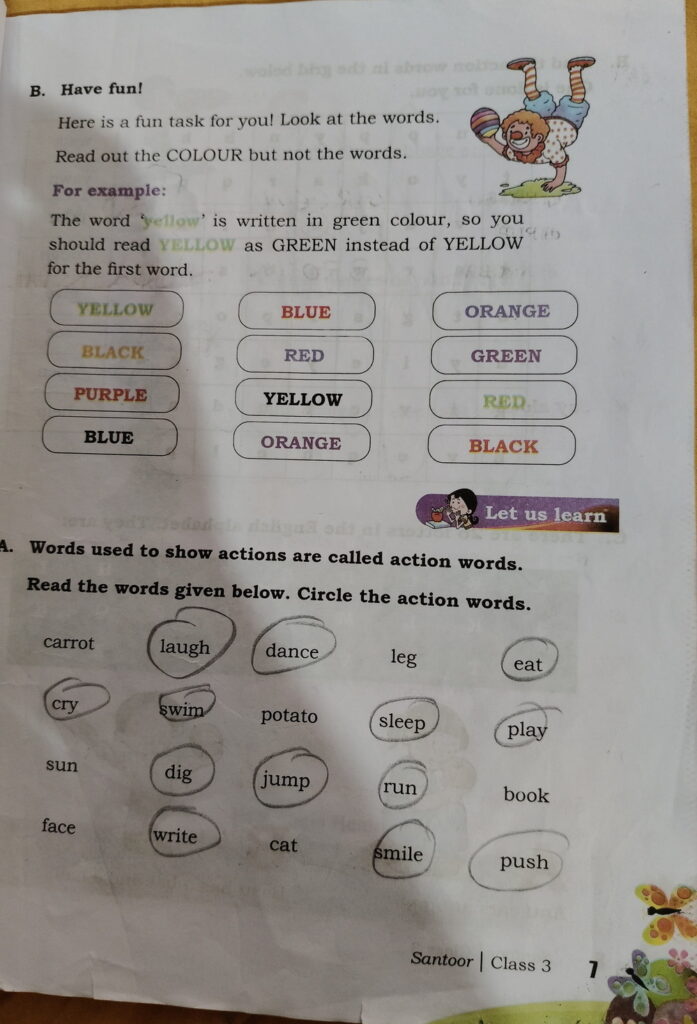
B. Have Fun!
Here is a fun task for you! Look at the words.
आपके लिए एक मज़ेदार काम है। शब्दों को देखिए।
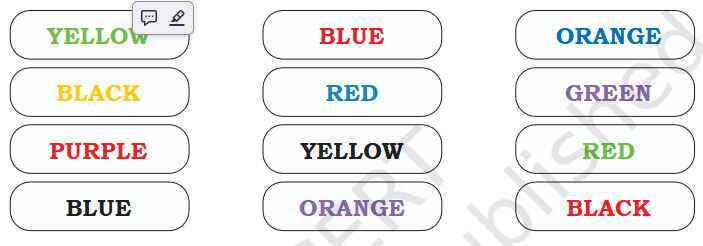
Read out the color but not the words.
शब्दों को नहीं, बल्कि रंगों को बोलकर बताइए।
For Example:
The word ‘yellow’ is written in green colour, so you should read YELLOW as GREEN instead of YELLOW
for the first word
पहले शब्द “yellow” हरे रंग में लिखा है, इसलिए आपको पहले शब्द के लिए YELLOW नहीं, बल्कि GREEN पढ़ना है।

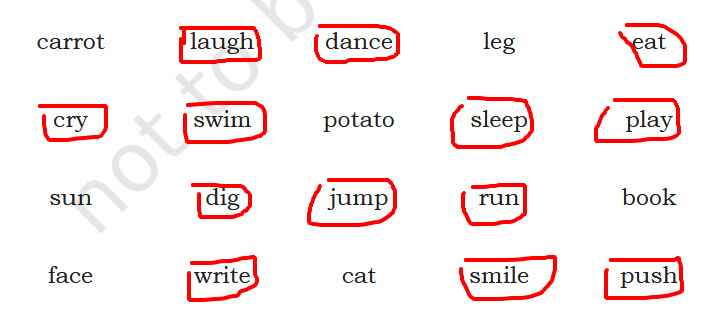
A. Words used to show actions are called action words.
शब्दों का उपयोग किसी कार्य को दर्शाने के लिए किया जाता है, उन्हें क्रिया शब्द कहा जाता है
Read the words given below. Circle the action words.
नीचे दिए गए शब्दों को पढ़िए। क्रिया शब्दों पर गोला लगाइए।
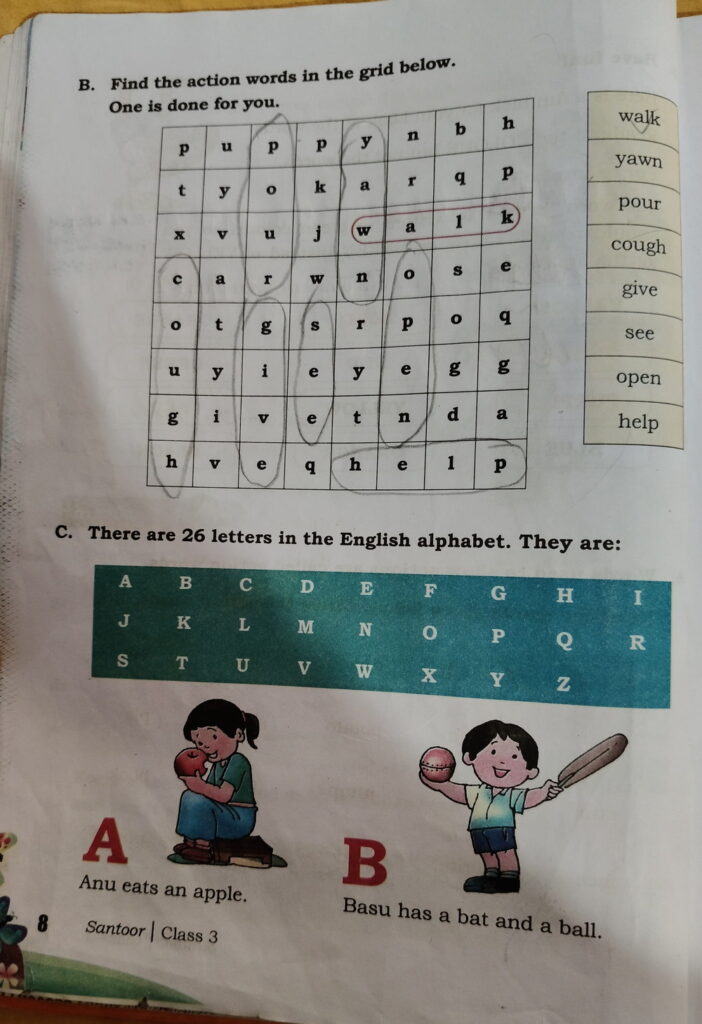
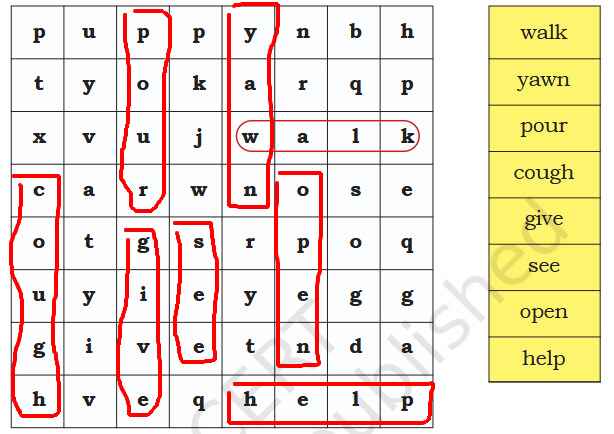
B. Find the action words in the grid below. One is done for you
नीचे दिए गए ग्रिड में क्रिया शब्दों को ढूँढिए। एक आपके लिए पहले ही किया गया है।
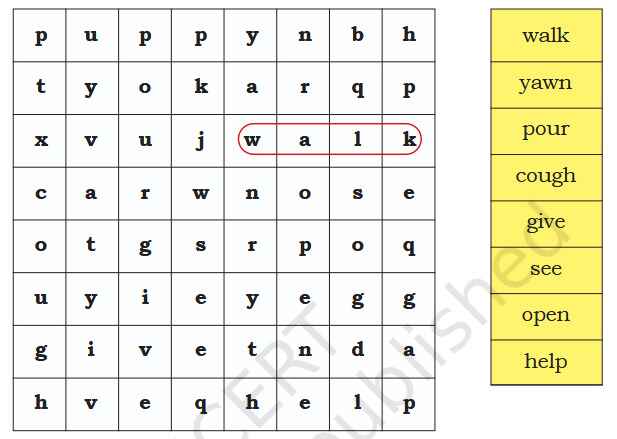
Answer:
In the answer, we have circled the words inside the yellow box to create the answer.
उत्तर में, हमने पीले बॉक्स के अंदर दिए गए शब्दों पर गोला लगाकर उत्तर बनाया है।
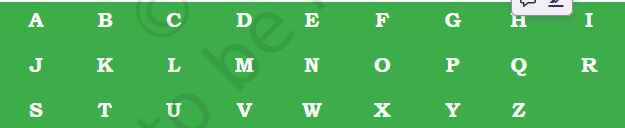
C. There are 26 letters in the English alphabet. They are:
अंग्रेज़ी वर्णमाला में 26 अक्षर होते हैं। वे हैं:
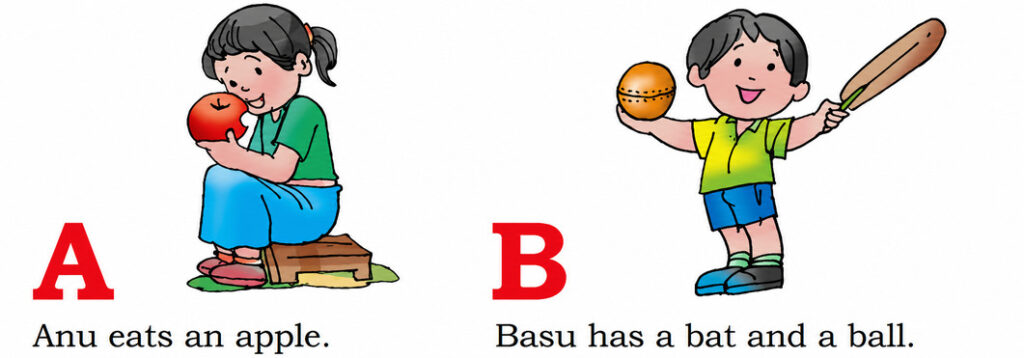
(A) Anu eats an apple.
A अनु एक सेब खाती है।
(B) Basu has a bat and a ball.
B बसु के पास एक बल्ला और एक गेंद है।
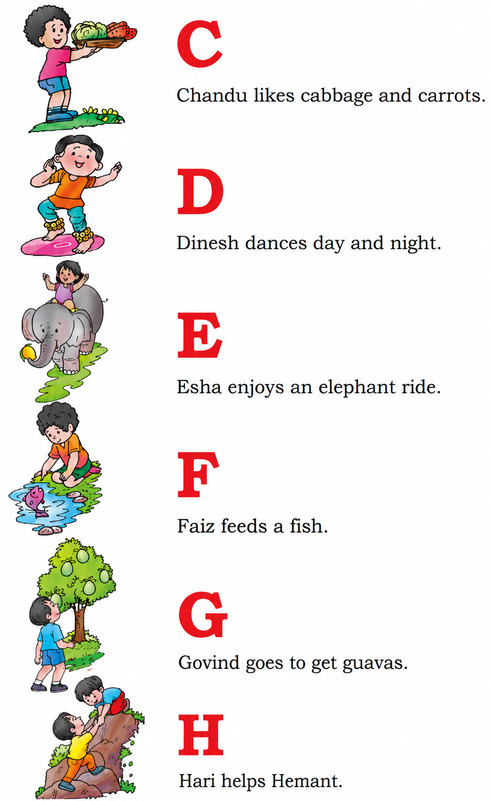
(C) Chandu likes cabbage and carrots.
चंदू को पत्तागोभी और गाजर पसंद हैं।
(D) Dinesh dances day and night.
D दिनेश दिन-रात नाचता है।
(E) Esha enjoys an elephant ride.
E ईशा को हाथी की सवारी करना पसंद है।
(F) Faiz feeds a fish.
F फ़ैज़ एक मछली को खाना खिलाता है
(G) Govind goes to get guavas.
G गोविंद अमरूद लेने जाता है।
(H) Hari helps Hemant.
H हरी हेमंत की मदद करता है।
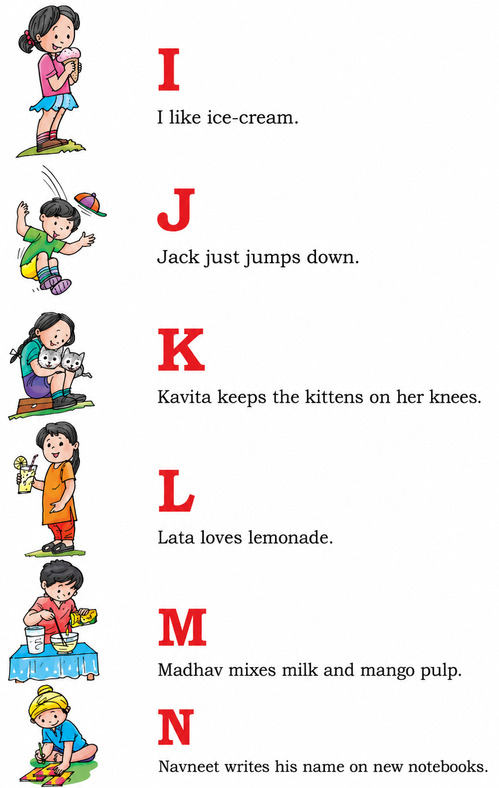
(I) I like ice-cream.
I मुझे आइसक्रीम पसंद है।
(J) Jack just jumps down.
J जैक बस नीचे कूद जाता है।
(k) Kavita keeps the kittens on her knees.
K कविता बिल्ली के बच्चों को अपने घुटनों पर रखती है।
(L) Lata loves lemonade.
L लता को नींबू का शरबत बहुत पसंद है।
(M) Madhav mixes milk and mango pulp.
M माधव दूध और आम का गूदा मिलाता है।
(N) Navneet writes his name on new notebooks.
N नवनीत नई कॉपियों पर अपना नाम लिखता है।
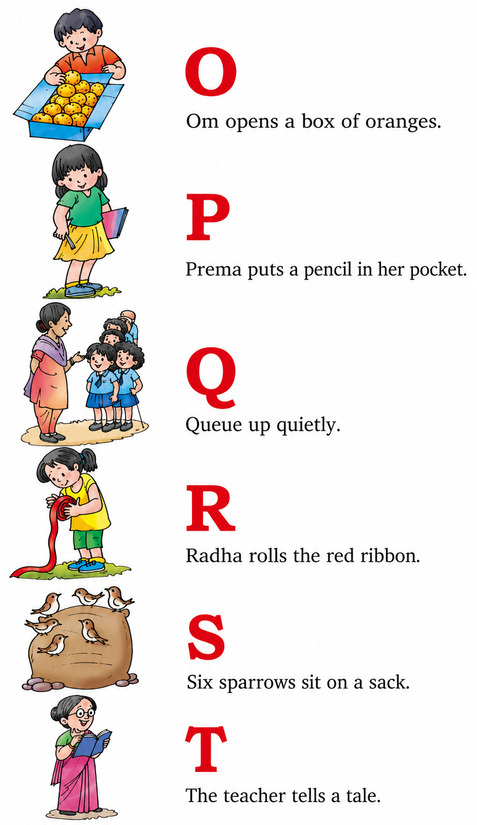
(O) Om opens a box of oranges.
O ओम संतरों का एक डिब्बा खोलता है।
(P) Prema puts a pencil in her pocket
P प्रेमा अपनी जेब में एक पेंसिल रखती है।
(Q) Queue up quietly.
Q शांतिपूर्वक पंक्ति में खड़े हो जाओ।
(R) Radha rolls the red ribbon.
R राधा लाल रिबन को लपेटती है।
(S) Six sparrows sit on a sack.
S छह गौरैयाँ एक बोरी पर बैठी हैं।
(T) The teacher tells a tale.
T शिक्षक एक कहानी सुनाते हैं।
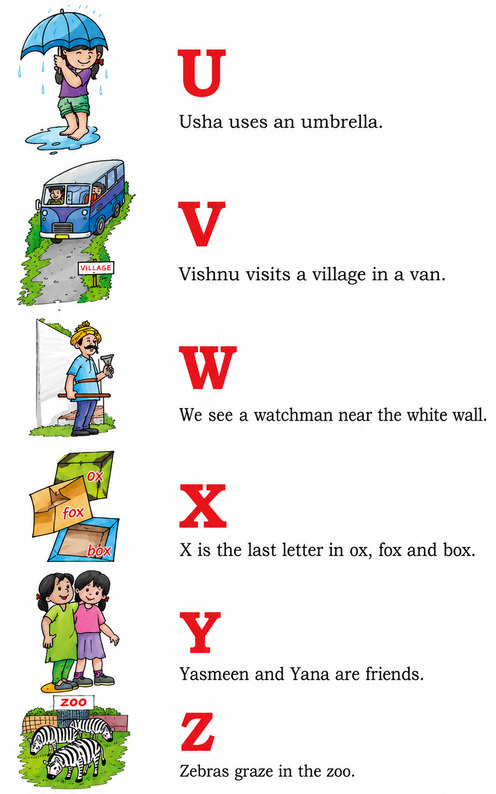
(U) Usha uses an umbrella.
U उषा एक छाते का उपयोग करती है।
(V) Vishnu visits a village in a van
V विष्णु वैन से एक गाँव जाता है।
(W) We see a watchman near the white wall.
W हम सफेद दीवार के पास एक चौकीदार को देखते हैं।
(X) X is the last letter in ox, fox and box.
X. Ox, Fox और Box शब्दों का अंतिम अक्षर X है।
(Y) Yasmeen and Yana are friends.
Y यासमीन और याना दोस्त हैं।
(Z) Zebras graze in the zoo.
Z ज़ेब्रा चिड़ियाघर में घास चरते हैं।
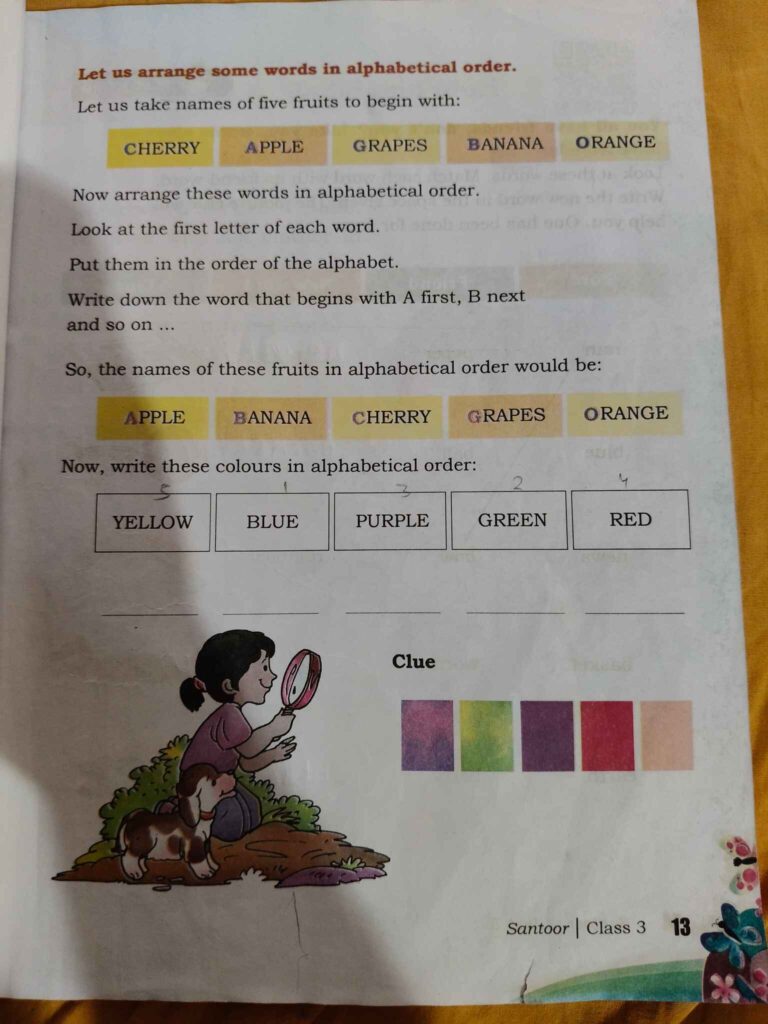
Let us arrange some words in alphabetical order.
आइए, कुछ शब्दों को वर्णमाला के क्रम में व्यवस्थित करें।
Let us take names of five fruits to begin with:
शुरुआत करने के लिए, आइए पाँच फलों के नाम लेते हैं।

Now arrange these words in alphabetical order.
अब इन शब्दों को वर्णमाला के क्रम में व्यवस्थित करें।
Look at the first letter of each word.
प्रत्येक शब्द के पहले अक्षर को देखिए।
Put them in the order of the alphabet.
उन्हें वर्णमाला के क्रम में लिखिए।
Write down the word that begins with A first, B next
and so on …
सबसे पहले उस शब्द को लिखिए जो A से शुरू होता है, फिर B से शुरू होने वाला शब्द, और इसी प्रकार आगे लिखते जाइए।
So, the names of these fruits in alphabetical order would be:
इस प्रकार, इन फलों के नाम वर्णमाला के क्रम में इस प्रकार होंगे:
Answer उत्तर

Now, write these colours in alphabetical order:
अब इन रंगों के नाम वर्णमाला के क्रम में लिखिए।

Answer उत्तर
Blue Green Purple Red Yellow
नीला, हरा, बैंगनी, लाल, पीला
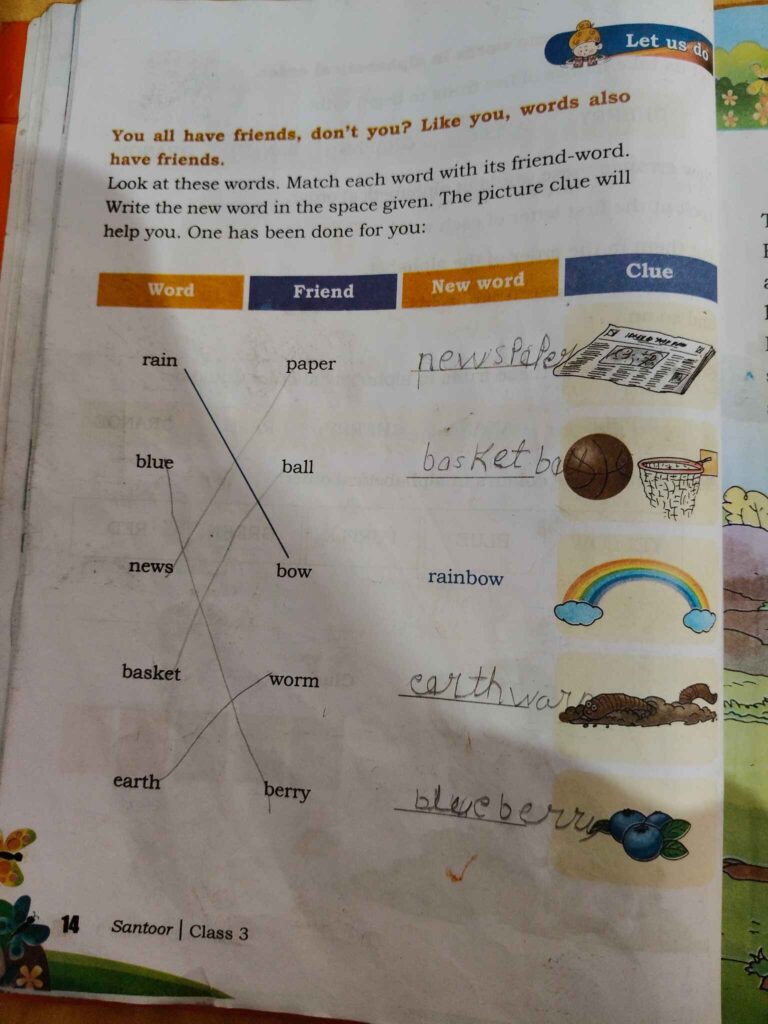
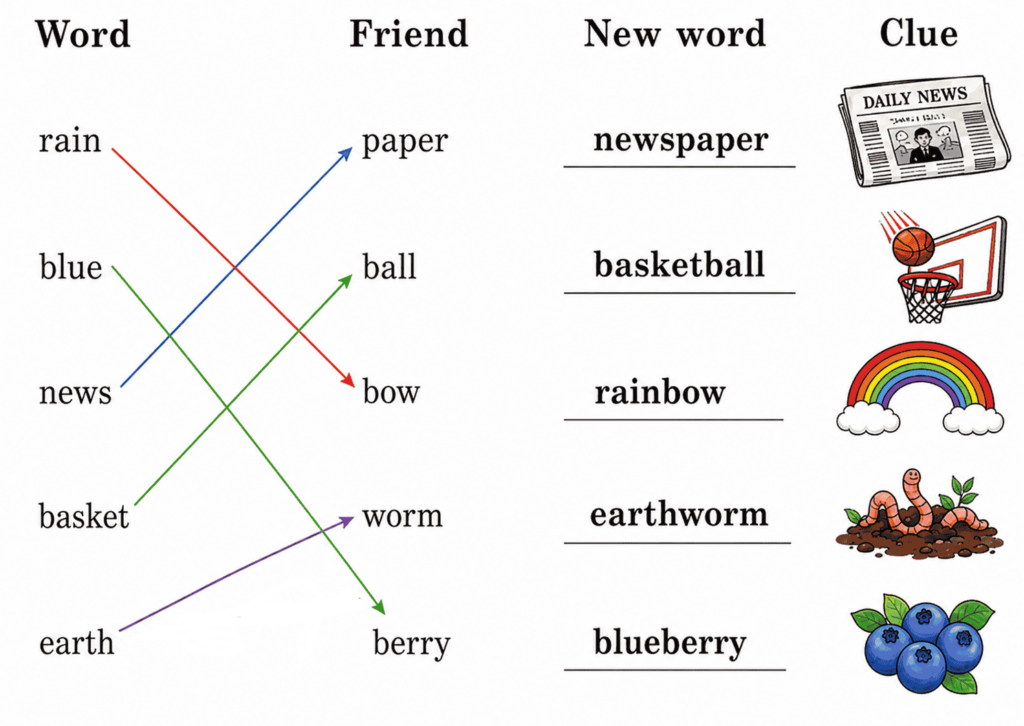
You all have friends, don’t you? Like you, words also have friends.
आप सभी के दोस्त हैं, है न? ठीक आपकी तरह, शब्दों के भी दोस्त होते हैं।
Look at these words. Match each word with its friend-word. Write the new word in the space given. The picture clue will help you. One has been done for you:
इन शब्दों को देखिए। प्रत्येक शब्द को उसके मित्र-शब्द (संबंधित शब्द) से मिलाइए। बने हुए नए शब्द को दिए गए स्थान पर लिखिए। चित्र में दिए गए संकेत आपकी सहायता करेंगे। एक उदाहरण आपके लिए करके दिया गया है।
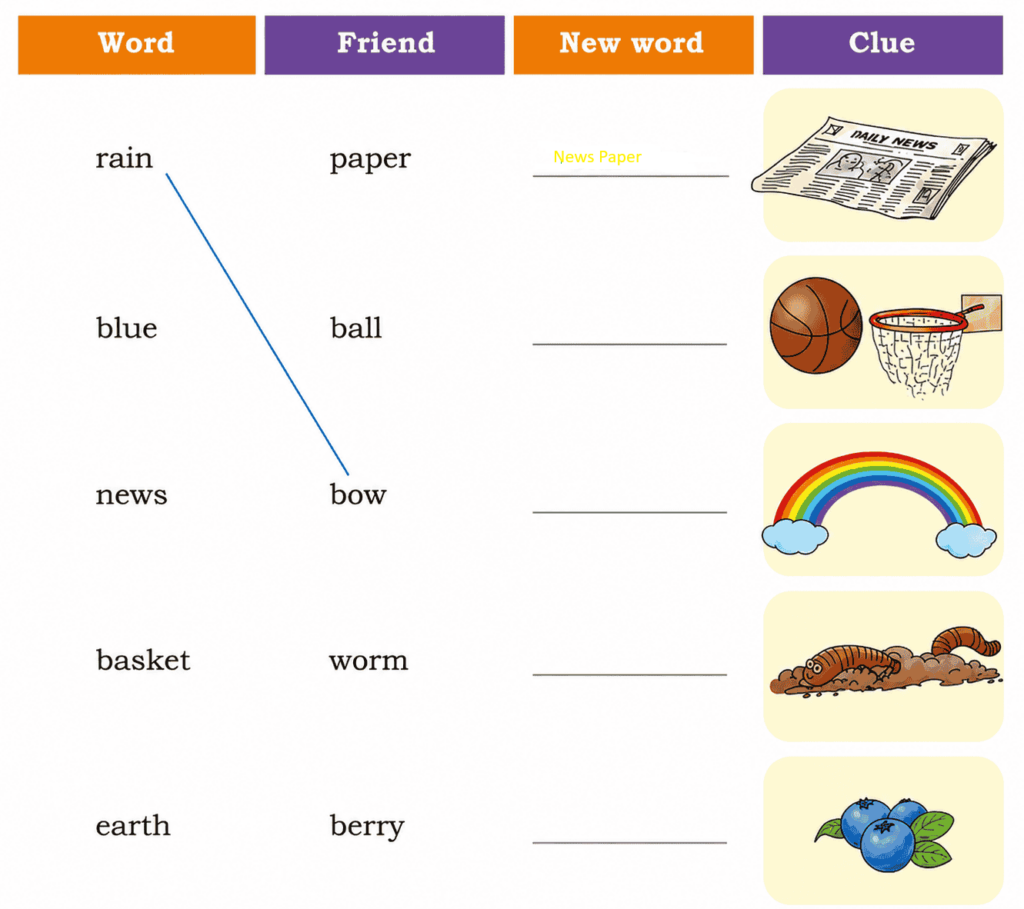
Answer उत्तर